Alabama Lands $7.1 Million To Boost Oyster Restoration Along The Gulf Coast
Limestone rock, live oysters, and volunteer oystermen are all part of a growing push to reverse decades of decline
Orange Beach, Ala. — (OBA) — Alabama's oyster population has been struggling for decades, and state officials and conservation groups are fighting back on multiple fronts. The Alabama Department of Conservation and Natural Resources recently received $7.1 million in Natural Resource Damage Assessment funds to support a major reef restoration project. The effort aims to increase oyster numbers and rebuild the resilience of oyster populations along the coast. Officials say the work will take about two years and involve a network of connected reefs spanning a range of habitats and salinity levels.
Funding comes through the Deepwater Horizon Oil Spill NRDA Trustee Council. ADCNR Commissioner Chris Blankenship serves as Alabama's lead Trustee on the council and oversees project selection and implementation. The project, formally titled Improving Resilience for Oysters by Linking Brood Reefs and Sink Reefs, will create high-vertical-relief brood reefs that connect to sink reefs via larval transport. ADCNR's Marine Resources Division and Deepwater Horizon Restoration Section are collaborating with the University of South Alabama and Auburn University to identify the most effective restoration sites and methods.
While the long-term project gets underway, shorter-term grassroots efforts are also taking shape along the Alabama Gulf Coast. Craig Newton, Marine Resources Division District Supervising Biologist, said oyster catchers and environmental groups have stepped up to help stabilize the struggling reefs. "There have been grassroots efforts over the past couple of years," Newton said. "They've taken it upon themselves to do whatever they can to provide somewhat of a quick relief and provide some benefits to the oyster population."
Newton noted that Alabama's oysters have been largely confined to two areas in recent years. "Since the 2000s, our oysters have been primarily restricted to one main area," Newton said. "Historically, our oysters have ranged from Whitehouse Reef off Alabama Port south to the Cutoff at Jemison's (Bait Shop across from Heron Bay), with Buoy Reef, Cedar Point, Heron Bay, and Portersville Bay as areas of significant harvest. All these places had oysters. For the last 15-20 years, we've been mostly restricted to Heron Bay and Cedar Point."
One of the largest recent restoration projects was carried out by the Alabama Wildlife Federation Oyster Restoration Initiative. About 4,600 tons of washed limestone rock were hauled from the Tuscumbia area to the Tombigbee River, loaded onto barges, and transported the length of the state to the Dauphin Island area before being placed near Cedar Point. AWF Executive Director Tim Gothard said the 50-acre Cedar Point West Oyster Cultch Planting builds on an existing partnership.
"This is our second large-scale cultch planting project in the Cedar Point area," Gothard said. "Those projects would not take place without these key partners. AWF is committed to the Coastal Alabama Comprehensive Oyster Restoration Strategy, developed by ADCNR Marine Resources Division in conjunction with NOAA. On-the-ground and on-the-water conservation work is just part of AWF's DNA, and we value the opportunity to make projects like this a reality."
Gothard added that the limestone offers a long window for oyster larvae to settle. "The 4,600 tons of limestone rock oyster cultch provides a significant window of opportunity, up to a decade or more, for the right conditions to come together so oyster larvae can attach and successfully develop," he said. He said the goal is to see oysters of multiple age classes grow on the site, including those of commercial harvest size.
Newton explained that limestone was chosen over oyster shells because of its durability. "Oyster shells generally last about five years before they break down. Limestone lasts upwards of 10 years," he said. "The idea is that this long-term, durable material will provide quality settlement substrate and hopefully the environmental conditions are suitable during that time period to result in some type of generational survivorship of the oysters."
A previous planting in the Cedar Point Beach area showed early promise before conditions turned. "In 2023, AWF planted No. 4 limestone in 77 acres in the Cedar Point Beach area," Newton said. "We saw some short-term success with the settlement of larvae on that Cedar Point Beach plant. Upwards of 6 million larvae were in that 77 acres. However, those larvae essentially died the following year due to freshwater, drills, and possibly other stresses from the environmental conditions that are fighting against our oyster population. The good news is the reef material is still there and can grow new oysters this year if the conditions are right."
Alabama's oyster harvest last season, which typically starts in October, totaled 5,153 sacks, or 210,000 meat pounds, from state waters. That is a dramatic drop from the state's most recent peak of 1.2 million meat pounds in 1992. MRD Director Kevin Anson credited the state's oyster catchers for taking matters into their own hands.
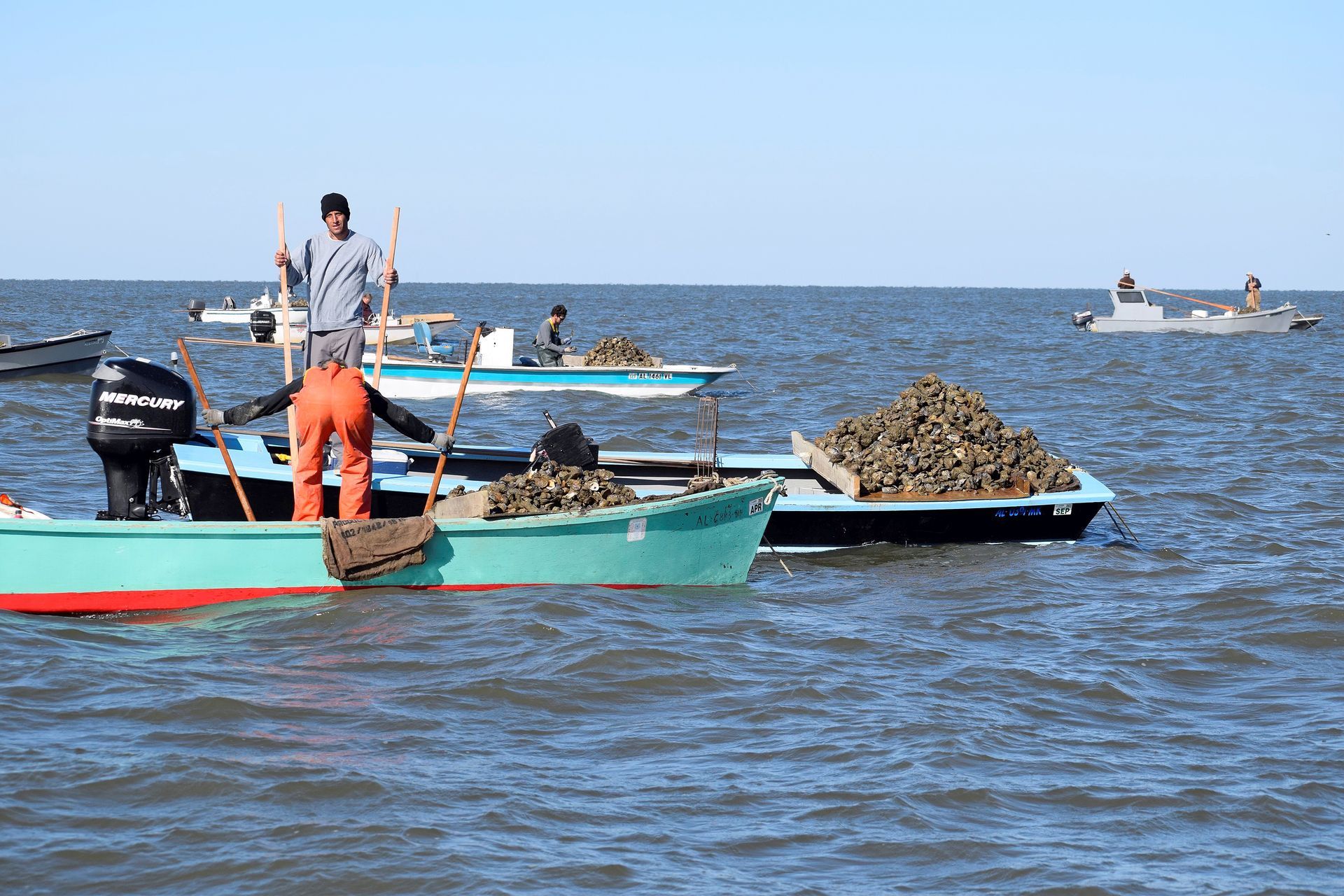
"We have a group of seasoned oyster catchers who have been catching oysters nearly their entire lives," Anson said. "They have seen this transition from really good catches of oysters back in the 90s, and they've seen in recent years the dramatic decline in the populations of oysters. So, they took it upon themselves to volunteer their time to deploy oyster shell that they have sourced from seafood dealers. They wanted to put something back, literally, back into the system and their industry."
MRD issued special permits allowing the oyster catchers to deploy shells and sample oysters with tongs before returning the oysters to the water. Anson said the exercise helped biologists identify the best locations for future restoration work. Newton said the program is also exploring new methods, including planting live oysters. Early attempts with small oysters had limited success, while a newer effort uses larger 2-inch oysters in hopes of better survival.
"It's important to keep working on these novel approaches," Newton said. "Traditional methods aren't working like they used to when we could just plant the bottom with oyster shells anywhere on the reef. I'm proud of these other groups executing these projects. We have to think outside the box and find alternative methods to affect positive change on oyster restoration efforts. The NRDA oyster project and partnering with AWF and the oyster catchers will do just that."
Share this article w/ Friends...