Tropical Fish Once Rare In Alabama Now Showing Up Along The Coast
A species once found only in South Florida is now being hooked from Perdido Bay to the Mississippi line
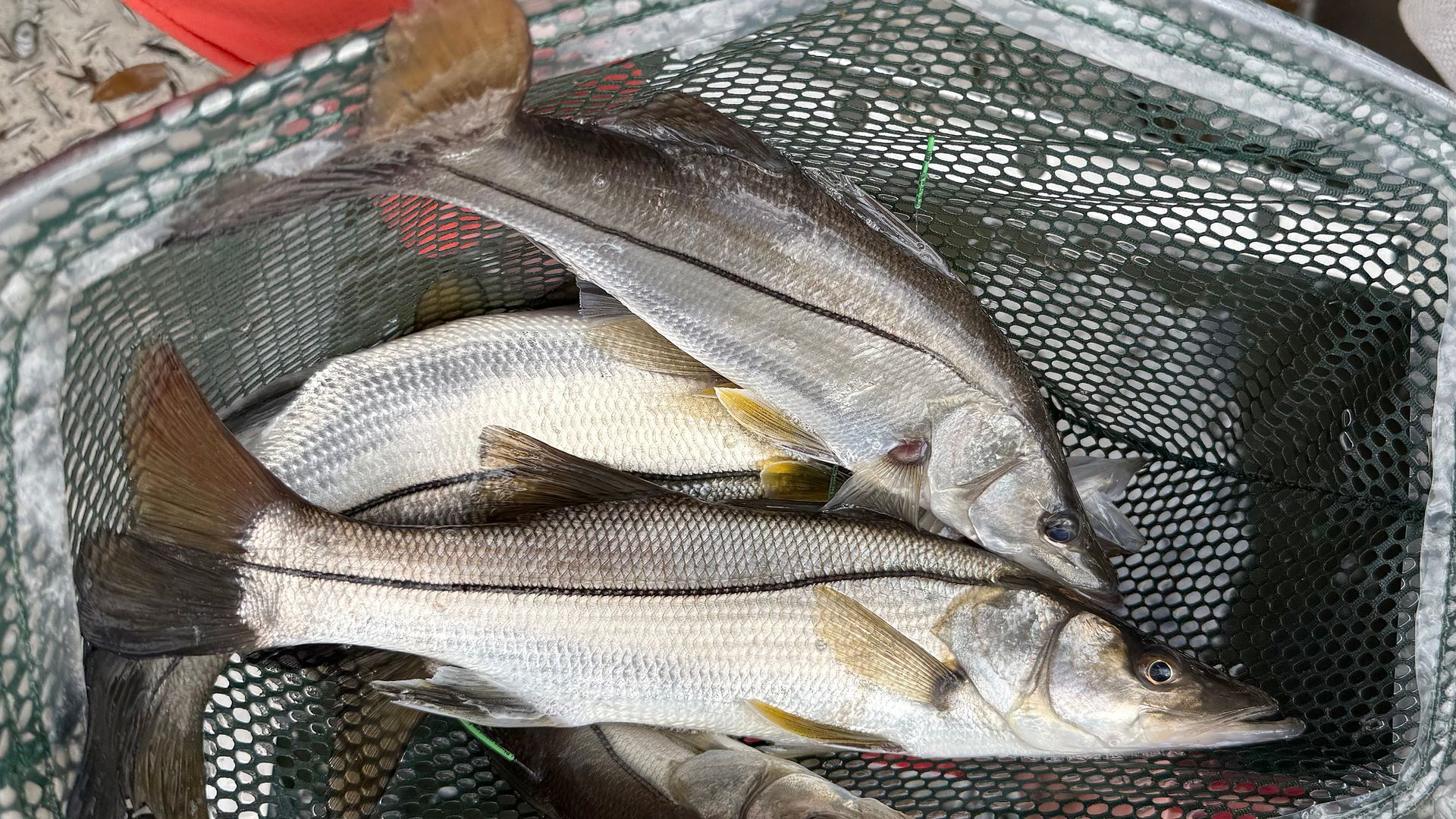
Orange Beach, Ala. — (OBA) — A fish with the word "common" in its name has been anything but common in Alabama's coastal waters — until now. Anglers along the Alabama Gulf Coast are increasingly catching common snook, a species once found mainly in South Florida. The fish's growing presence has caught the attention of researchers at the University of South Alabama and the Dauphin Island Sea Lab. Scientists are now working to document how many snook are appearing and where they are going.
Dr. Charlie Martin, a north Alabama native who works at both the University of South Alabama and the Dauphin Island Sea Lab, began tracking the fish after anglers reported catches. He first encountered the species in 2016 while on staff at the University of Florida near Cedar Key. Martin later returned to Alabama and soon began hearing reports of snook along the coast.
"The historic range extended from just north of Tampa to the south along the Gulf side," Martin said. "I started on the staff at the University of Florida in 2016, working around Cedar Key. We started catching snook there, big ones, and I wrote a paper about it. I earned my Ph.D. at the University of South Alabama, and Dr. (Sean) Powers recruited me to return to Alabama."
Martin said the spread has been significant and continues to grow. Snook have now been reported not only in Alabama but also along the Florida Panhandle and as far west as Mississippi. He added that, given Dauphin Island's proximity to the Mississippi state line, such reports are not surprising.
"Then all of a sudden, there's all these reports of snook showing up in coastal Alabama," Martin said. "I followed the snook all the way to the northern Gulf. We've had reports in the Florida Panhandle, and we've had some reports from Mississippi. Of course, if you catch them at Dauphin Island, it's not that far to Mississippi."
Anglers have reported more than 150 snook hooked in Alabama waters, but Martin believes the actual number is much higher. The fish has generated excitement among the coastal fishing community, including local fishing guides.
"That's quite a bit, but that's just what gets reported," he said. "There's likely way more that don't get reported. There's a lot of excitement around it, and a lot of the fishing guides are really excited."
Kevin Anson, Director of the Alabama Department of Conservation and Natural Resources' Marine Resources Division, said snook are not the only tropical species appearing in state waters. He noted that bonefish and African pompano have also become more frequent in recent years. Anson said such occurrences often coincide with back-to-back warm winters.
"From time to time we have captured bonefish, considered more of a fish from tropical waters, and its occurrence usually coincided with periods of time when we've had warm winters for two or three winters in a row," Anson said. "African pompano have been caught more frequently than in the past. We have some increase in species not routinely caught off Alabama in the most recent time period of 50 or so years."
Anson said the state is closely monitoring the snook research but acknowledged that Alabama's habitat differs from Florida's, where most snook studies have been conducted. He said building a solid data set for Alabama will take time.
"We will certainly be interested in any information on snook that Charlie and his staff and students are gathering," Anson said. "We just don't have a lot of data. The state of Florida has done a lot of research, and that's where we've gone to try to understand its biology and life cycle. That is what we've been using so far, but our habitat is significantly different than the habitat where most of the research has been conducted. There may be differences in age and growth and reproduction in the northern Gulf. It will take a while to build up a good body of that research, but we're appreciative of any research they (USA) can do for that species."
Adam Rhodes of Elberta currently holds the Alabama state record for snook at 13.7 pounds, a fish he caught in February. For comparison, a 72.6-pound snook was landed off the coast of Costa Rica earlier this year.
Water temperature plays a major role in determining where snook can survive, and Martin said that is why the fish are only now appearing this far north. He explained that snook seek out thermal refuges — deep,
"At 10° C (centigrade, 50 degrees Fahrenheit), they are not going to hang around," Martin said. "Or if they are around, they're going to find some warm water, some thermal refuges. What we're finding, we think, is that some of these coastal rivers have deep spots where the water is stratified. The cold water will be on top, and the more insulated water down deep, where they can survive one or two weeks of cold."
Martin also noted that snook are more adaptable to salinity than most people realize. He said the fish can survive in fully freshwater and has been reported far inland in Florida.
"Snook are a real interesting fish," Martin said. "Globally, that family of fish is more of a river species than a marine fish. The common snook we have here is kind of an outlier. We think of them as saltwater fish, but they can survive in full freshwater. When I was in Florida, we had snook reports coming from all the way up to the Okefenokee Swamp. In salinity tolerance, snook are more tolerant of freshwater than even redfish."
The epic winter storm that hit the Alabama coast in January 2025, dropping eight to 10 inches of snow, gave Martin an unexpected opportunity to test snook's cold-weather resilience. The results surprised even him.
"We found that snook were still around after that cold weather we had in January last year," he said. "That was a lot of snow. I never expected to see that in my lifetime. But, the next month, we took the electrofishing boat out and shocked snook in Weeks Bay and its tributaries. We get reports from all over our coastal waters, like Fowl River and Fish River. The highest concentration seems to be in Baldwin County around the Perdido Bay area."
Martin said no one yet knows whether the snook's range will continue to expand. The species is also expanding along the South Carolina Atlantic Coast, the Texas Gulf Coast, and the east coast of Florida. His team is now using acoustic tags to track fish movements and hopes to study the impact of snook on local ecosystems.
"Of course, we're documenting their presence," he said. "We also want to know where they go in the wintertime, those thermal refuges. They are probably like a manatee. Manatees have to find that warm water, so they could be in the same places. We're tagging some fish to get movement patterns."
Martin described snook as aggressive predators that are also highly sought after by sport fishermen. He said their behavior and physical traits make them a unique catch.
"Eventually, we want to start looking at what kind of impact they have because these are voracious predators," he said. "They're a lot of fun to catch, and they eat just about everything. They have a big mouth, like a largemouth bass, and some people fish for them the same way. They like getting into structure with their head poking out, ready to ambush any kind of prey."
Martin is asking all Alabama anglers who hook a snook to report the catch by emailing
hookedasnook@gmail.com,
cmartin@disl.org, or
zhendrickson@disl.org. Reports should include the approximate date of the catch, the general location, a size estimate, and, if possible, a photo.
The Alabama Department of Conservation and Natural Resources' Marine Resources Division has already set size and bag limits for snook: a one-fish daily bag limit and a 28-inch minimum total length. Anson said the regulation was implemented early to protect a fish that is still establishing itself in the region.
"This was a preemptive way to regulate a fish, albeit a limited number of fish, compared to other traditional species here," Anson said. "It was to make sure there wasn't too much harvest, as it appears to be establishing itself in this part of the Gulf."
Share this article w/ Friends...